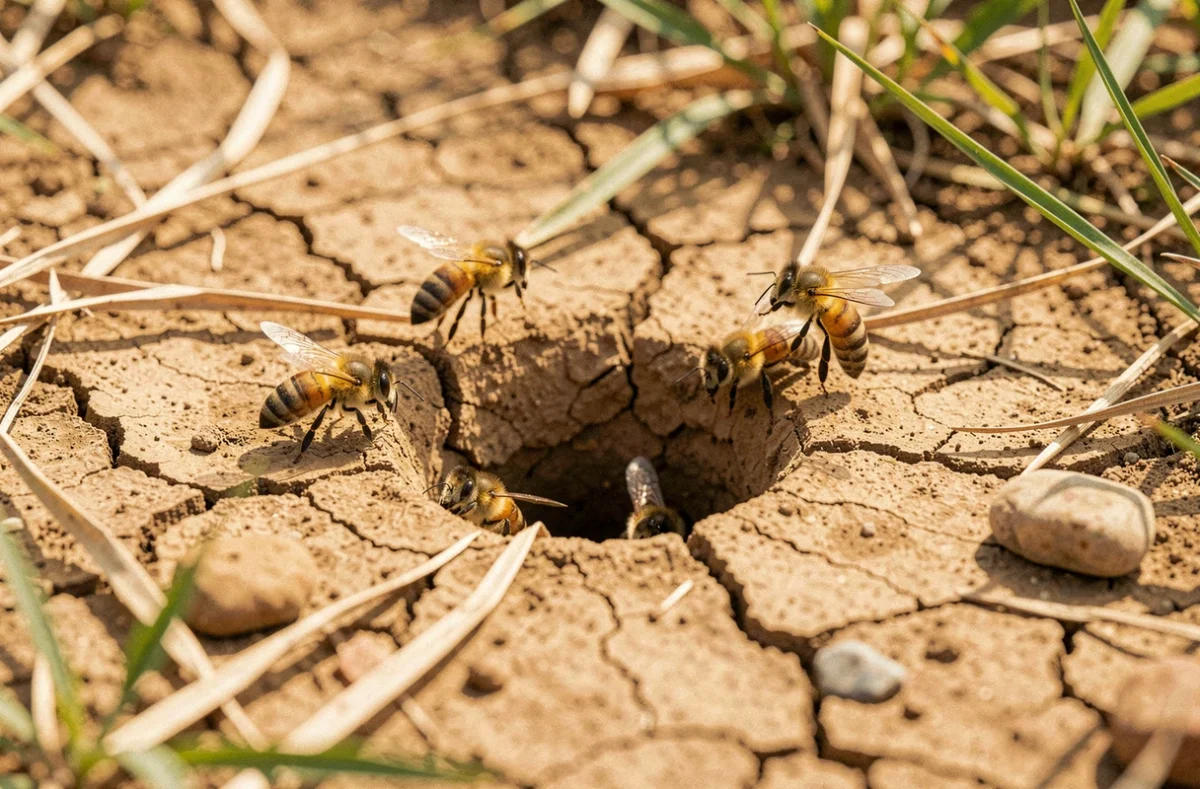
A small round hole in the lawn, insects buzzing around: the first question to ask is not “is it dangerous?”, but “who lives there?”. Underground nests can house solitary bees, bumblebees, or digging wasps. Each species leaves visible clues as long as you know where to look. Correctly identifying the occupant of a nest in the ground determines the appropriate reaction, as the stakes for protection differ radically from one insect to another.
Anatomy of a hole in the ground: what the shape of the entrance reveals
Competitors mainly compare aerial nests (beehives, paper-mâché nests under roofs). The underground case follows different rules. A single, well-circular hole, with a diameter comparable to that of a pencil, generally indicates a solitary digging bee (Andrena, Colletes, Halictus). These bees each dig their own tunnel in loose, sandy, or slightly clayey soil.
Several dozen closely spaced holes in the same area do not signify an organized colony. Solitary bees nest in aggregation: each female manages her own tunnel, but they choose the same bank or border of a flowerbed because the soil conditions suit them. Small mounds of fine earth are often observed around each opening, resembling mini-volcanoes.
To recognize a bee nest in the ground, it is also necessary to examine the traffic. A single occupant enters and exits through the tunnel at a slow and steady pace. If dozens of insects converge towards a wider opening, the diagnosis changes.
Ground wasp or bumblebee: dense traffic towards a single entrance
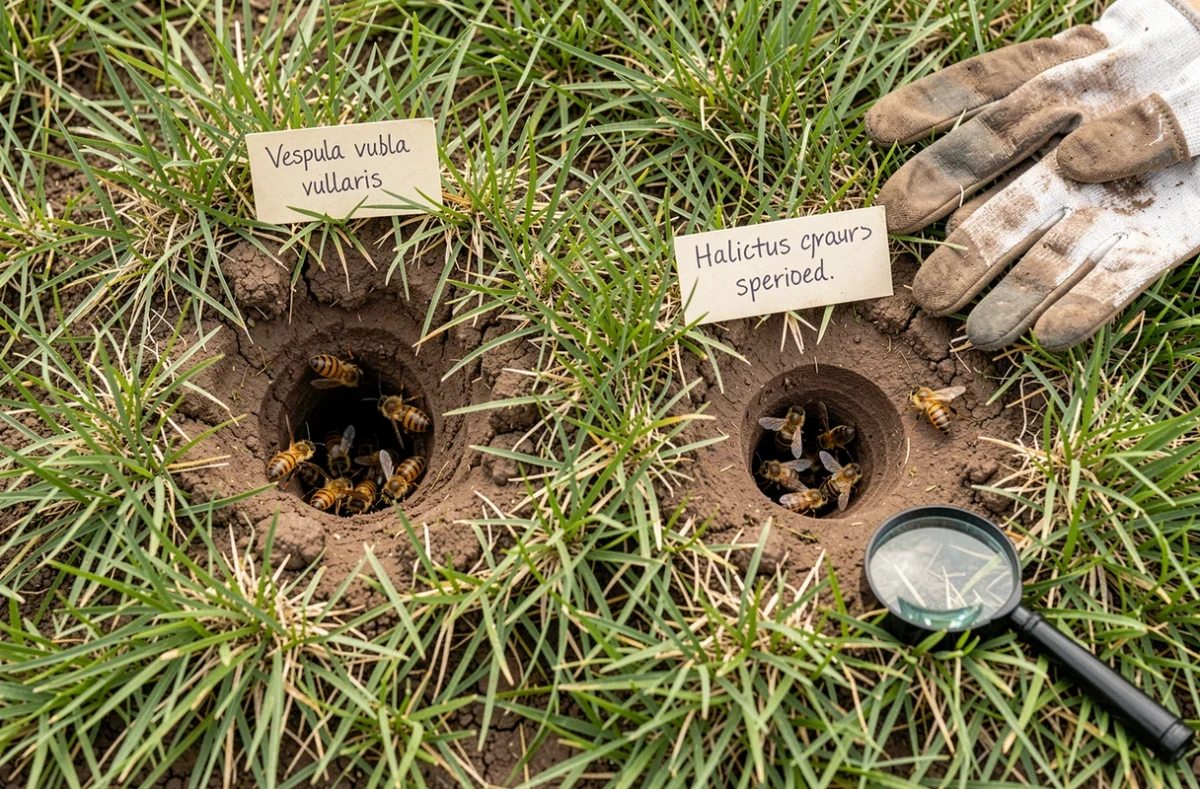
A single entrance larger than one centimeter in diameter, with sustained back-and-forth movement, points to two possible occupants: a colony of digging wasps (Vespula vulgaris, Vespula germanica) or a nest of ground bumblebees (Bombus terrestris). In both cases, the insect has often repurposed an old rodent burrow rather than digging one itself.
The distinction relies on three observable criteria from a distance, without needing to approach within two meters:
- The silhouette of the flying insects: the ground bumblebee is stout, very hairy, with a rounded abdomen often ending in a white tip (the famous “white bottom”). The wasp is slimmer, almost hairless, with a very marked waist between thorax and abdomen.
- The sound: the bumblebee produces a deep and continuous buzzing. The wasp emits a higher-pitched and more nervous sound, often audible from several meters away when the colony is active.
- The defensive behavior: ground bumblebees are not very aggressive and only sting if you walk directly on the entrance of the nest. Ground wasps react from a greater distance and can attack in groups if they perceive repeated vibrations (lawnmower, stomping).
The traffic at the hole is more informative than its appearance alone. Regular comings and goings towards the same opening indicate an active colony, but are not enough to distinguish between wasp and bumblebee without observing the insects themselves.
Solitary bee in the ground: should you intervene or protect the nest?
Solitary bees do not form a defensive colony. They do not have a honey reserve, do not protect a queen, and their sting is too weak to penetrate human skin in most cases. Their presence in a lawn or flowerbed is an indicator of good soil health and local biodiversity.
Solitary bees are protected and should not be destroyed. Blocking their tunnels, watering the area extensively, or applying an insecticide amounts to eliminating pollinators that directly contribute to the fertilization of fruit trees and vegetable plants in the vicinity.
The visible activity period rarely lasts more than four to six weeks in spring. After laying eggs, the tunnels naturally close. If their location is problematic (pedestrian path, playground), the solution is to modify the soil texture after their departure: adding dense compost or thick mulch is enough to make the area less attractive the following season.
Underground wasp nest: the right reflexes before acting
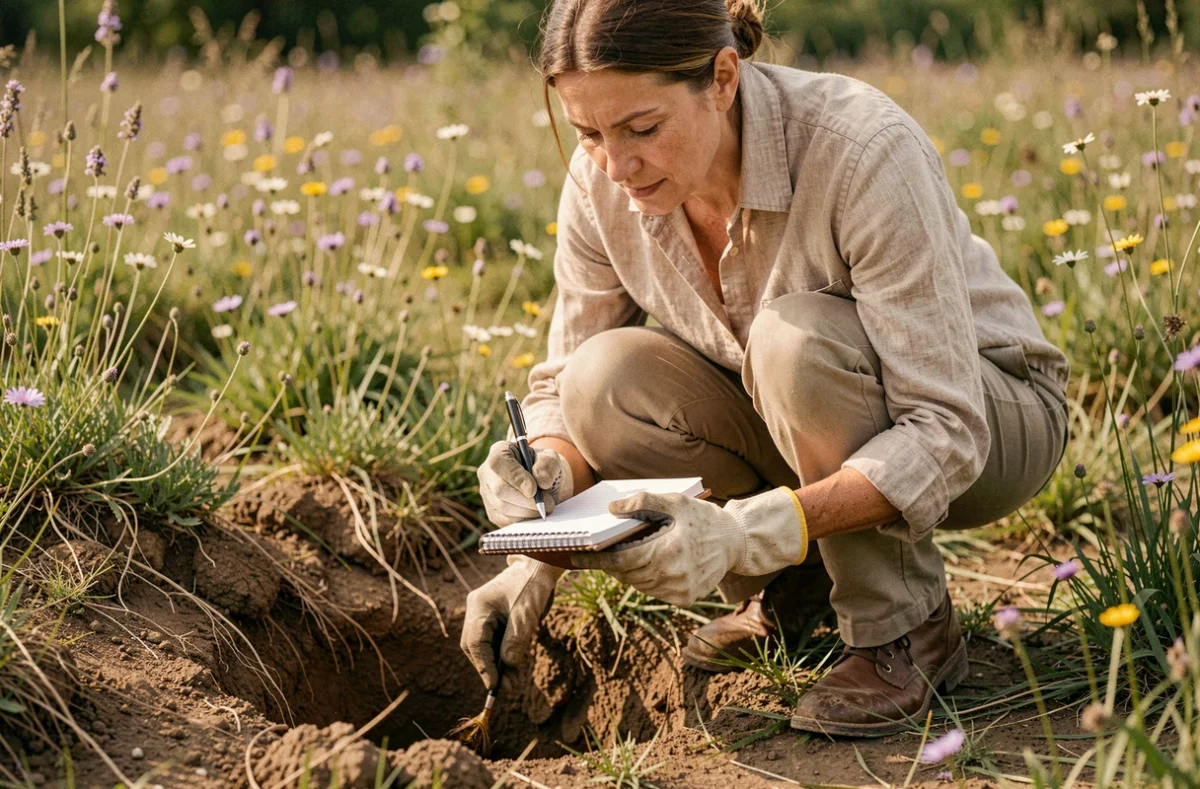
When faced with a confirmed wasp nest in the ground, the situation is different. Underground wasps can form colonies of several hundred individuals in the height of summer. Never block the entrance of an active wasp nest: the workers will seek an alternative exit and may emerge unpredictably, sometimes inside a building if the burrow connects with a crawl space.
The intervention depends on the context. A nest located at the back of the garden, far from passage areas, can be left in place: the colony dies naturally with the first frosts and will not be reused the following year. However, a nest close to a terrace, house entrance, or an area frequented by children justifies calling a pest control professional.
The obligation to destroy does not rest on the individual systematically. Some municipalities cover all or part of the destruction costs when the nest is located on public roads or poses a danger to safety.
Summary table: solitary bee, bumblebee, or wasp in the ground
| Criterion | Solitary Bee | Ground Bumblebee | Ground Wasp |
|---|---|---|---|
| Nest entrance | Small round hole, often in aggregation | One wider entrance, old burrow | One entrance, old burrow or cavity |
| Silhouette | Small, moderately hairy | Stout, very hairy, white tip | Slender, hairless, very marked waist |
| Aggressiveness | Almost none | Low except for direct contact | High if vibrations or proximity |
| Recommended action | Do not touch, protected species | Do not touch, useful pollinator | Assess the risk, call a pro if necessary |
The majority of holes observed in French lawns in spring are the work of solitary bees, not wasps. Observing before acting remains the most reliable rule: two minutes of attention to the silhouette and behavior of the flying insects is enough to avoid an identification error that could cost the lives of pollinators.