Succeeding in your garden in 2026 means dealing with a central constraint: the availability of water. Prefectural watering restrictions are multiplying, heatwaves are shortening planting windows, and some once-reliable plants are showing their limits. What parameters should be measured and compared to concretely adapt a garden to these new conditions?
Water Restrictions and Garden Watering: What Local Regulations Say
Competitors talk about watering without addressing the regulatory framework that conditions it. During periods of drought, prefects set alert levels that can prohibit the watering of lawns, flower beds, and potted plants, or limit vegetable garden watering to certain time slots.
The official site VigiEau allows you to check the applicable measures for a specific address. Before planning a watering schedule, consulting this platform helps avoid exposure to sanctions.
| Alert Level | Vegetable Garden Watering | Lawns and Flower Beds Watering | Pool Filling |
|---|---|---|---|
| Vigilance | Allowed (recommended times) | Allowed with moderation | Allowed |
| Alert | Restricted times (evening/night) | Limited or prohibited depending on the order | Subject to conditions |
| Reinforced Alert | Very limited slots | Prohibited | Prohibited |
| Emergency | Prohibited except by exemption | Prohibited | Prohibited |
This table summarizes the main points, but details vary from one department to another. In Côte-d’Or, new restrictions came into effect at the end of September 2026, with targeted prohibitions starting at the alert level. The thematic sections found on the entire Jardiner Facile site cover, among other things, water-saving watering techniques adapted to these constraints.
Heat-Resistant Plants: Comparison from Real-World Trials
Talking about “heat-resistant” plants remains vague unless the observation conditions are specified. The Jean-Marie Pelt botanical garden in Villers-lès-Nancy tested flower beds without watering during heatwaves. The results published by Modes et Travaux in September 2026 allow for a comparison of the performance of several species.
Species Tested Without Watering at the Jean-Marie Pelt Botanical Garden
- Buenos Aires Verbena: flowering maintained during heat peaks, airy growth that limits evaporation from the soil.
- Shrubby Sage: good overall performance, persistent foliage even in full sun, well-drained soil required.
- Stonecrops and Cinerarias: dense ground cover, low water needs, suitable for borders and rockeries.
- Ornamental Grasses: confirmed resistance, structuring effect in flower beds, almost no maintenance once established.
The method relies on three combined factors: a well-draining soil to avoid root rot, a thick mulch, and generous but spaced watering during the first two years of establishment. After this rooting period, these plants do not require additional water.
In contrast, feedback from experts gathered in Nantes shows that trees over twenty years old resist heatwaves significantly better than recent plantings.
Vegetable Garden Watering: Frequency vs. Volume, Key Data to Remember
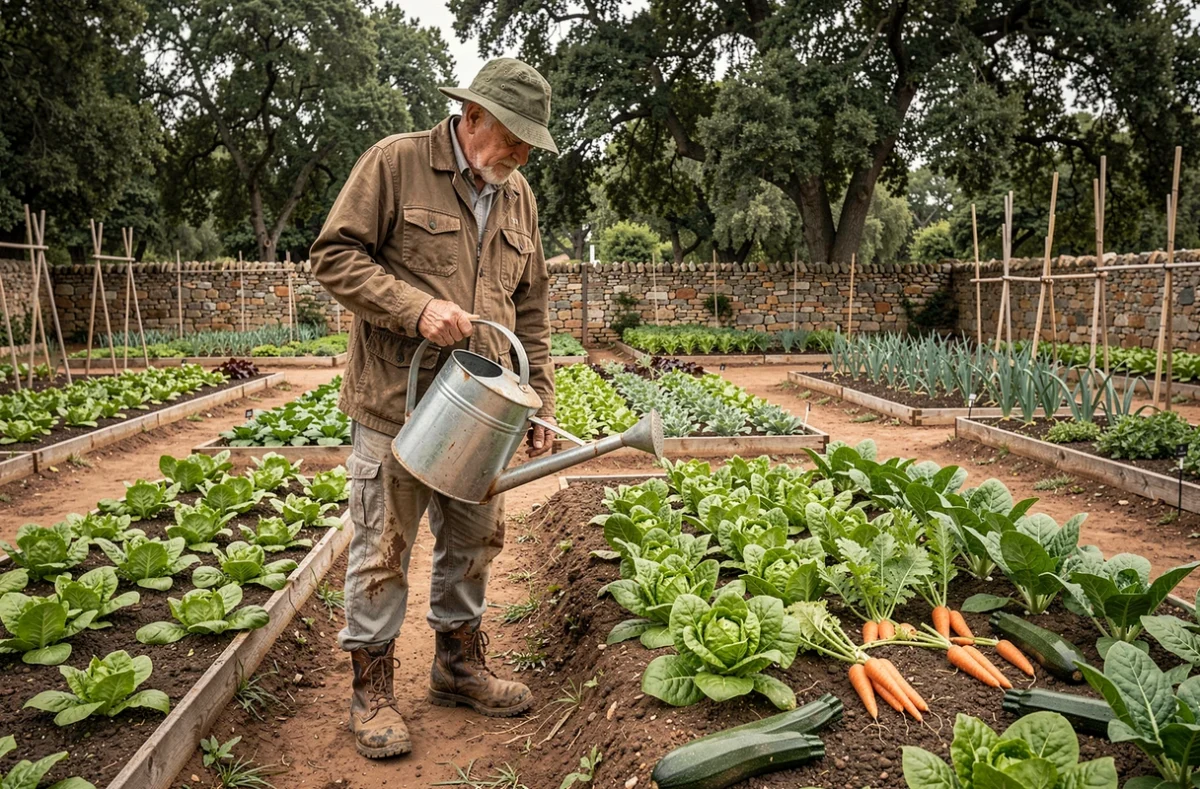
Classic advice recommends watering “regularly” without quantifying. However, a counterintuitive principle emerges from market gardening practices: watering rarely but generously yields better results than frequent and shallow watering.
A light daily watering moistens the top few centimeters of soil. Roots remain near the surface and become dependent on human input. Abundant watering spaced several days apart forces roots to dig deeper for moisture, making the plant more autonomous during dry spells.
Practical Tips for Saving Water in the Vegetable Garden
Mulching remains the most effective lever. A layer of straw, wood chips, or dead leaves limits evaporation and keeps the soil cool for several days after watering.
A soil never left bare, protected year-round by living plants or organic mulch, significantly reduces dependence on watering. This principle of permanent coverage, combined with appropriate soil management, helps retain moisture longer in depth.
Garden Maintenance Without Pesticides: Alternatives That Work
The use of synthetic pesticides is increasingly regulated for individuals. Finding preventive solutions rather than curative ones has become a priority to protect crops without resorting to chemical treatments.
Green manures sown in September-October are an effective preventive alternative. Mustard, phacelia, or clover cover the soil during winter, limit weeds, and enrich the soil with nitrogen upon decomposition. This technique, documented by Iriso, prepares a more fertile vegetable garden without any chemical inputs.
The biodiversity of the garden also plays a direct role in pest regulation. Maintaining mixed hedges and unmowed areas promotes beneficial organisms (ladybugs, lacewings, hedgehogs) that naturally regulate aphid and slug populations.
Climate change is also altering historical maintenance references. For a private garden, choosing plants suited to the current climate, not to that of thirty years ago, remains the most structurally significant decision in the long term.