The external and internal obliques ensure the rotation of the torso, lateral flexion, and stabilization of the trunk in multiple planes of movement. These two muscle layers, located on either side of the abdomen, are involved in nearly all sports movements and daily postures. Their strengthening is not limited to an aesthetic goal: it conditions the strength of the entire abdominal belt.
Anti-movement exercises and dynamic rotations: two distinct approaches for the obliques
Most training programs group together movements that engage the obliques in very different ways under the same label. Distinguishing these two families allows for the selection of exercises based on actual goals, rather than randomly picking from a list.
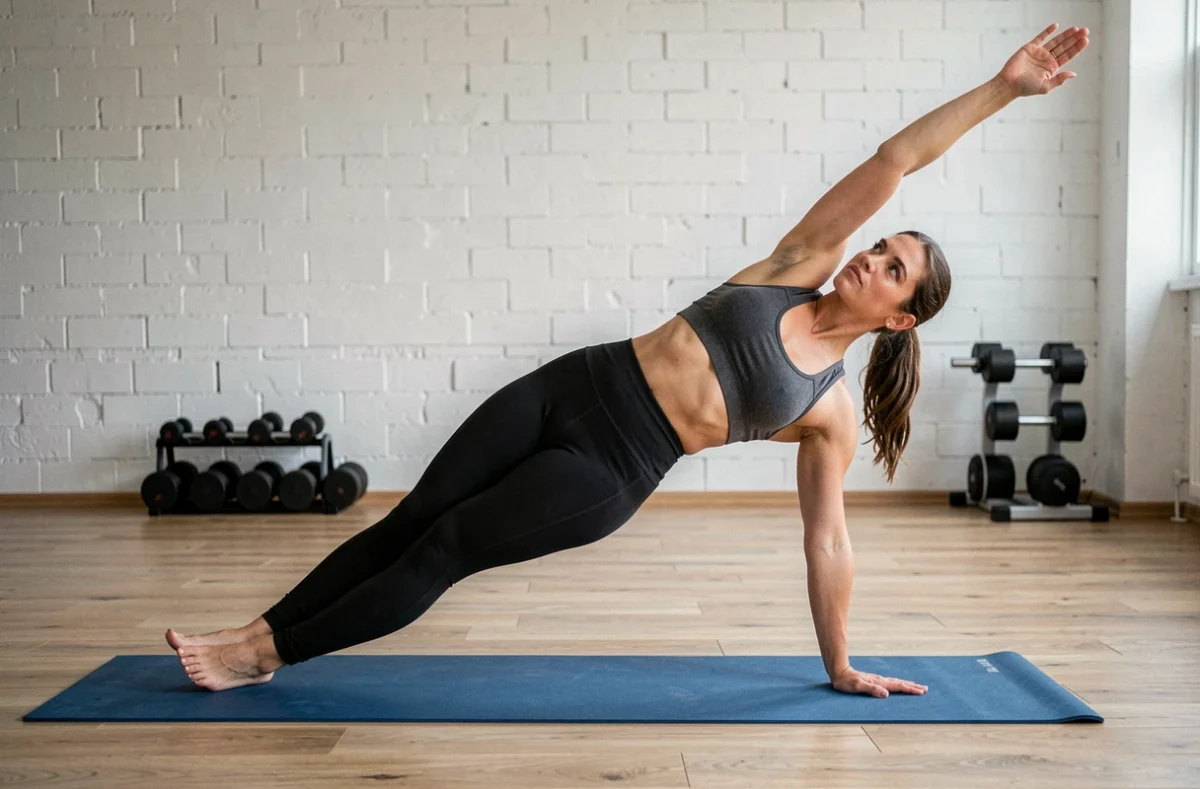
Anti-movement exercises aim to prevent the trunk from moving under external pressure. The side plank is the most well-known example: the body resists gravity without rotation or inclination. This type of work engages the obliques in isometric contraction and develops local stabilization of the spine.
Dynamic rotations, such as the woodchop at the pulley or the ground rotation with a medicine ball, mobilize the obliques in their function of controlled torso rotation. An intervention study published in 2026 reports that rotary work was associated with specific adaptations of the obliques and improved trunk mobility in several planes, without the authors concluding that one method was superior to the other.
In other words, mastering oblique abdominal exercises requires combining these two approaches rather than sticking to just one. A program that includes only static stabilization overlooks rotary mobility, and vice versa.
Obliques and back pain: what strengthening can (and cannot) do
The argument often comes up: strengthening the obliques protects the back. The reality deserves clarification.
The obliques participate in trunk stabilization and can help limit stress on the lumbar vertebrae during asymmetric movements. In this sense, their strengthening is a relevant lever for prevention.
For individuals suffering from chronic low back pain, the situation is more nuanced. Available data indicate that stabilization exercises are not superior to other forms of exercise for reducing low back pain. Strengthening the obliques represents one option among others, not a guaranteed remedy.
This observation does not disqualify the work of the obliques. It invites us not to present it as the sole solution to a multifactorial problem. A well-structured abdominal strengthening program fits into a holistic approach, which may include hip mobility, spinal extensor work, and cardiovascular activity.
Three oblique abdominal exercises that deserve more attention
Rather than an endless list, here are three movements that cover the main functions of the obliques and are often poorly executed or underutilized.
Side plank with controlled rotation
The classic side plank works resistance to inclination. By adding a rotation of the free arm under the torso, we combine stabilization and rotary mobility in a single exercise. The body remains supported on one forearm and the feet, with the pelvis neither rising nor falling during the rotation.
The stationary pelvis during rotation is the execution criterion that distinguishes this exercise from a simple arm movement. If the pelvis wobbles, the load is too high or the time under tension is too long.
Pallof press (resistance to rotation)
Standing with feet hip-width apart, hold a cable or resistance band at chest level. Push the arms in front of you without allowing the trunk to rotate towards the source of resistance. The obliques work here in pure anti-rotation.
- The distance between the feet and the anchor point of the resistance determines the intensity: the further away you are, the greater the rotary strain
- The exercise can also be performed on knees to reduce the base of support and engage the pelvic stabilization more
- Maintaining the arms extended for a few seconds before returning to the chest increases the time under tension for the obliques
Slow woodchop at the pulley or with resistance band
This diagonal rotation movement, from low to high or from high to low, replicates a common motor pattern in sports and everyday life. The key lies in the slowness: a slowly performed woodchop engages the obliques more than a fast ballistic movement, as the muscle must control deceleration at each end of the range.
The feet remain anchored to the ground, with the legs slightly bent. The rotation starts from the trunk, not the arms. If the shoulders move before the pelvis, the movement loses its relevance for the obliques.
Frequency and progression: adapting the load for the obliques
The obliques are postural muscles that are constantly engaged. They recover faster than the larger muscle groups of the lower limbs. Two to three sessions per week, integrated into a general strengthening program, are sufficient to observe adaptations.
Progression first involves time under tension and execution quality, before increasing the load. A pallof press with moderate resistance and prolonged hold will be more effective than a woodchop with excessive load that forces compensation with the shoulders.
- Start with anti-movement exercises (side plank, pallof press) to build basic stabilization
- Gradually add controlled dynamic rotations (slow woodchop) once the trunk remains stable in isometric
- Vary the planes of work: lateral resistance, high-low rotation, low-high rotation, to cover all functions of the obliques
In a postpartum context, the choice of exercises may depend on the state of diastasis of the rectus abdominis and pelvic floor recovery. A medical or physiotherapy opinion remains relevant before resuming rotary work of the obliques.
Strengthening the obliques is neither limited to a series of side crunches nor a miracle program against back pain. It is a work of stabilization and mobility that becomes more effective when integrated into a comprehensive routine, adapted to each person’s level and executed with the slowness that these muscles require.