
The French market for protein powders offers several hundred references, including concentrated whey, isolate, plant proteins, and multi-source blends. The market authorization declaration to the administration does not certify either the effectiveness or the nutritional interest of the product: checks can occur after marketing. In this context, the choice relies less on label promises than on a careful reading of the composition, the manufacturing process, and the coherence with a specific goal.
Protein powder: what the label does not always allow you to verify
Before comparing types of proteins, one point deserves to be made. The health claims used on packaging are regulated by European legislation. Only certain mentions are allowed for proteins, notably the contribution to the maintenance of muscle mass and the maintenance of normal bone structure, under certain conditions.
Any promise that goes beyond this framework falls under marketing. A product that claims “guaranteed muscle growth” or “visible results in 15 days” is outside the scope of authorized claims. Knowing how to distinguish a regulatory mention from a commercial argument constitutes the first filter of selection, even before looking at the protein content per serving.
Another often overlooked angle concerns traceability. The safety of a product and the origin of its raw materials deserve to be a distinct selection criterion from its protein profile. In case of an adverse effect, the nutrivigilance system allows for reporting a dietary supplement, but the process remains little known to the general public. To know how to choose the best protein powder, these regulatory benchmarks are a more reliable foundation than online reviews.

Concentrated, isolate, or hydrolyzed whey: what is the real difference in digestion
The distinction between these three forms lies in the degree of filtration of the whey. Concentrated whey retains some lactose and lipids. The isolate undergoes additional filtration that significantly reduces lactose. The hydrolyzed form is partially pre-digested through an enzymatic process.
On paper, the hierarchy seems clear. In practice, digestive tolerance varies significantly from person to person. A good quality concentrated whey can be perfectly tolerated by someone who digests lactose without difficulty. Conversely, switching to an isolate does not systematically resolve discomfort if the issue comes from another ingredient (thickener, sweetener, flavor).
Rather than moving up the range by reflex, checking the complete list of ingredients remains more useful. An isolate with a composition as long as a paragraph is not necessarily better tolerated than a concentrate with three ingredients.
The case of lactose
People who are lactose intolerant logically turn to isolates or plant proteins. The residual amount of lactose in an isolate depends on the process used by the manufacturer. Not all isolates are equal on this criterion, and the mention “lactose-free” does not adhere to a single regulatory definition in sports nutrition.
Plant or animal protein: the real comparison parameters
The debate between whey and plant protein often boils down to a question of dietary conviction. However, the technical parameters deserve to be clearly stated.
- The amino acid profile: whey provides a complete amino acid profile, with a high concentration of leucine, an amino acid involved in muscle protein synthesis. Plant proteins from a single source (pea, rice, hemp) often present an incomplete profile, hence the interest in multi-source blends that compensate for the deficits of each plant.
- The speed of assimilation: whey is absorbed quickly, positioning it around training. Some plant proteins have a slower kinetics, without this being a disadvantage for recovery throughout the day.
- The texture and taste: plant proteins have long suffered from a grainy texture. Recent formulations have improved, but the difference remains noticeable in a shaker with water. However, when integrated into a recipe (pancakes, porridge), the gap narrows.
For muscle mass gain, a well-formulated plant blend can meet amino acid needs. The data that is still lacking in the literature accessible to the general public concerns long-term comparisons on large cohorts between whey and multi-source plant blends, under equivalent training conditions.
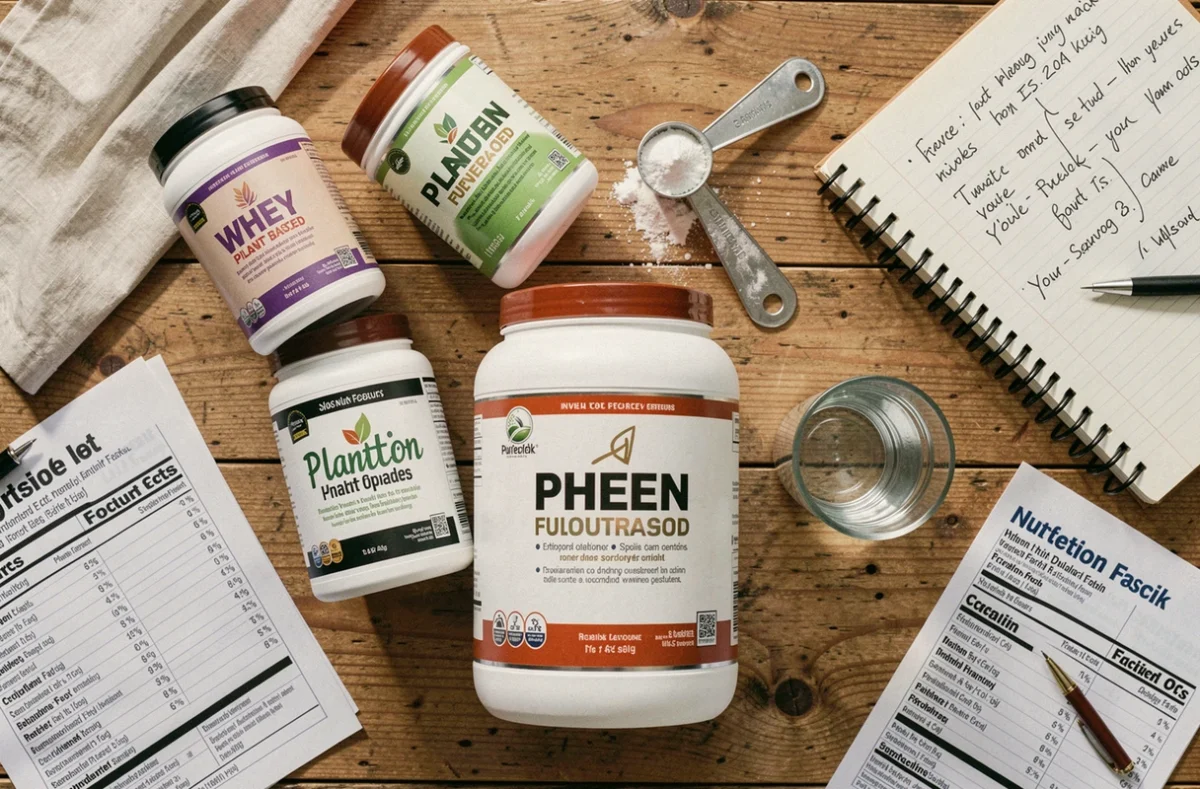
Quality criteria for protein powder: beyond the protein content
The percentage of protein per serving is the first figure looked at. It is not enough. Here are the criteria that truly differentiate two products displaying a similar rate.
- The presence of added amino acids (taurine, glycine) that artificially inflate the displayed protein content without providing the same biological value. This practice, sometimes called “amino spiking,” is not always visible at first glance on the label.
- The number of additives: thickeners, sweeteners, colorings. A product with fewer than five ingredients limits the risk of intolerances and makes it easier to identify a potential problematic component.
- The origin of the milk or plant raw material. A manufacturer that communicates the source (country, type of farming, certification) offers a level of transparency superior to one that merely mentions “whey protein.”
- Third-party certifications (heavy metal analyses, anti-doping tests for competitive athletes) provide an independent guarantee that the market authorization declaration does not offer.
Budget and protein powder for bodybuilding
The price per kilogram hides concentration discrepancies. Comparing the cost per gram of effective protein gives a more accurate picture. A moderately priced concentrated whey but dosed at a correct rate may be cheaper per gram of protein than a poorly dosed premium isolate.
The choice of a protein powder benefits from being treated as a nutritional decision, not as an impulsive purchase driven by packaging or a promo code. Reading the ingredient list, checking the amino acid profile when available, and testing digestive tolerance on a small amount before investing in an economical format remain the most concrete actions to avoid mistakes.