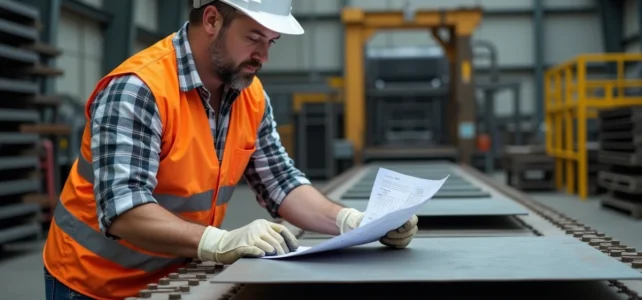
The convergence between precision metalwork and structural civil engineering is redefining how permanent access at height is designed, manufactured, and anchored. Laser cutting, CNC bending, and foundation beams are no longer confined to separate sectors: their coordination from the preliminary project stage conditions mechanical performance, regulatory compliance, and cost control of modifications.
BIM Coordination between the Reinforcement Plan of Foundation Beams and Anchor Plates
The customization of guardrail anchors, crinolines, and walkways according to the reinforcement plan of the foundation beams represents the most underutilized technical lever. Concrete modifications after pouring remain the primary source of additional costs on industrial height access sites.
Further reading : Optimize the presentation of your online articles with professional photography techniques
We recommend integrating reservations for plates and threaded rods directly into the digital model of the beam before sending it for prefabrication. This approach, documented by CTICM in its work on metalwork coupled with BIM, reduces thermal bridges and eliminates post-pouring penetrations.
The principle is simple: the DXF file of the laser-cut plate feeds into the IFC model of the beam. The rebar contractor positions the steel while considering the reservations, and the concrete is poured around the inserts. The result is a monolithic assembly whose pull-out resistance far exceeds that of a chemical anchor.
Read also : How to Optimize Your Online Study Time with MyCampus Eduservices
The prefabricated concrete sector has accelerated this convergence. Since 2023-2024, several manufacturers have been offering ranges of foundation beams compatible with Eurocode 8 for industrial and logistics roofs, natively integrating reservations for access equipment (air conditioning, solar panels, technical walkways). Combining these laser cutting, bending, and foundation beams solutions from the design phase avoids back-and-forth between the structural engineering office and the metalworker.
Laser Cutting and CNC Bending for Height Access Structures
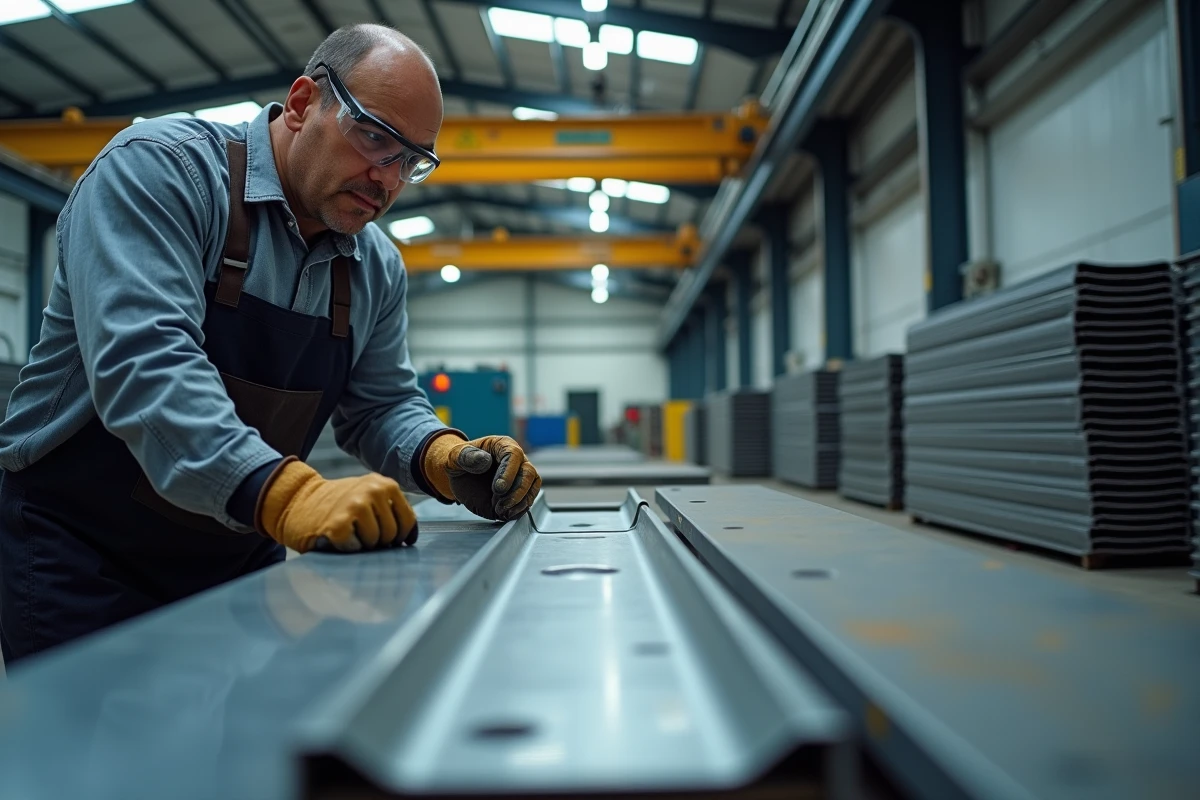
Fiber laser cutting on steel or aluminum allows tolerances of around one-tenth of a millimeter on plates, gussets, and column joints. For a crinoline or a walkway guardrail, this precision is game-changing during assembly: bolted connections fit into place without adjustment on site.
CNC bending complements cutting by eliminating corner welds on U or L profiles. A stair stringer bent in mass presents a continuous section, with no thermally affected areas, which improves fatigue resistance under dynamic loads (walkway vibrations, wind).
Critical Parameters to Lock in Upstream
- The sheet thickness conditions the minimum bending radius. A thick S235 steel requires a wider die angle, which modifies the final profile dimensions and thus the spacing of the fixings on the beam.
- The choice between hot-dip galvanized steel and aluminum 6060-T6 influences the laser parameters (power, speed, assist gas) and the surface treatment post-bending. Aluminum does not tolerate any residual burrs in the anchorage area, under penalty of galvanic corrosion upon contact with stainless steel inserts.
- The functional dimensioning of oblong holes must anticipate the dimensional tolerances of the prefabricated beam. We observe that engineering offices imposing round holes without adjustment play increase non-conformities during assembly.
Reviewing these parameters before manufacturing launch halves the installation time on site, as each piece arrives ready to bolt.
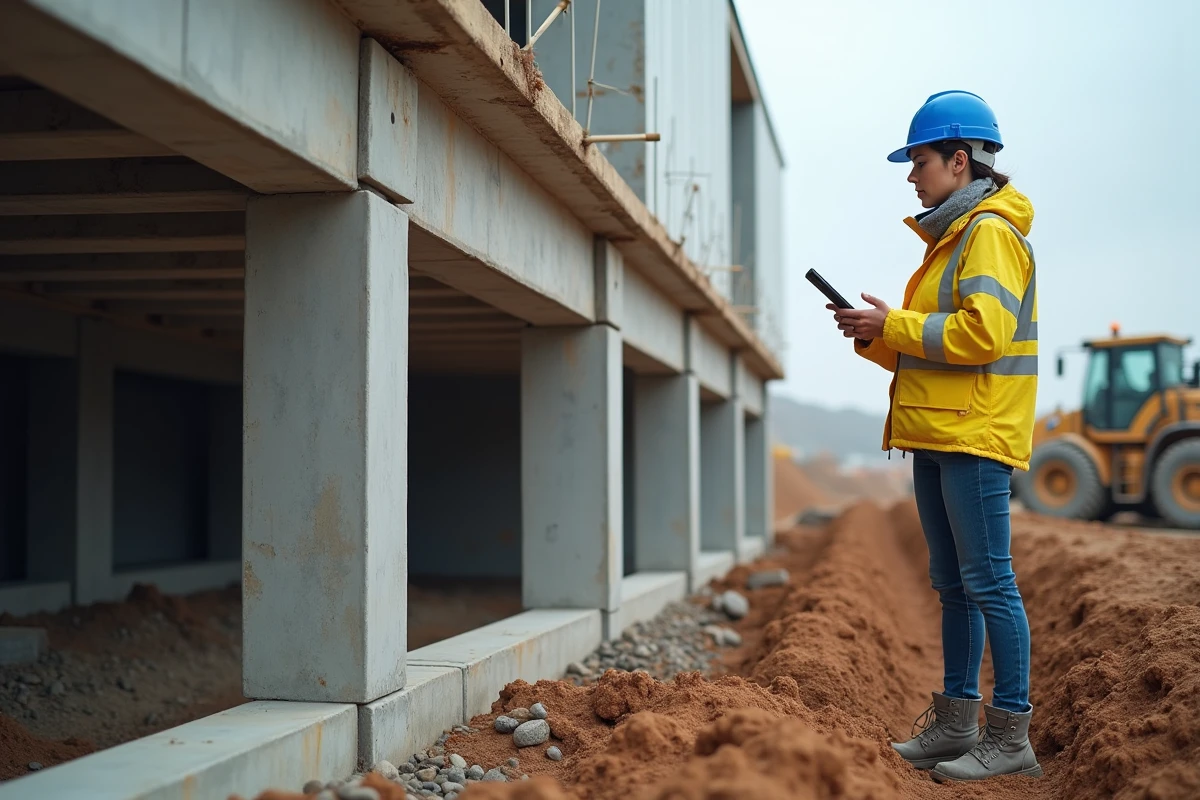
Prefabricated Foundation Beams and Seismic Requirements
Prefabricated beams for height access now meet seismic and extreme wind requirements on technical platforms. The Federation of the Concrete Industry has documented this evolution in its 2024 report dedicated to industrial and logistics buildings.
The seismic challenge modifies the sizing of anchorage expectations. In areas of moderate to medium seismicity, the base plates of guardrails must withstand cyclic horizontal forces. Therefore, the beam must integrate stitching reinforcements around each reservation, which requires close coordination with the metalworker from the APS stage.
Integration of Permanent Access from the Design Phase
The updated INRS and OPPBTP recommendations for 2023-2024 emphasize the integration of permanent access (fixed ladders, stairs, walkways) from the design phase, rather than relying on lifts or scaffolding for extended periods. This direction pushes project owners to plan reservations for beams and anchor plates from the preliminary project stage.
In practice, this means that the foundation lot and the metalwork lot must work on a shared model. The classic mistake is treating the beam as a simple load-bearing structural element, without integrating the point loads from access equipment. The result: reinforcements added during the construction phase, with delays and costs spiraling.
Dimensional Tolerances and Quality Control at Reception
The interface between a laser-cut metal part and a prefabricated concrete beam concentrates dimensional discrepancies. The reception control must focus on three points simultaneously: the position of the inserts in the beam, the geometry of the plates, and the correspondence between the two.
We recommend a physical control template, made from the same DXF file as the plates. This template, placed on the beam upon reception, checks in a few minutes that each insert falls within the tolerance of the planned oblong hole. This verification avoids late discoveries during assembly when the crane is already mobilized.
Laser traceability provides an additional advantage: each piece can be engraved with its plan reference, steel grade, and batch number. On a site with several dozen guardrails or walkway sections, this identification speeds up sorting and limits placement errors.
The interplay between the digital precision of metalwork and the dimensional robustness of prefabricated concrete remains the main point of vigilance. Projects that invest in this upstream coordination deliver compliant height access, installed quickly, and whose structural durability does not depend on improvised modifications on site.